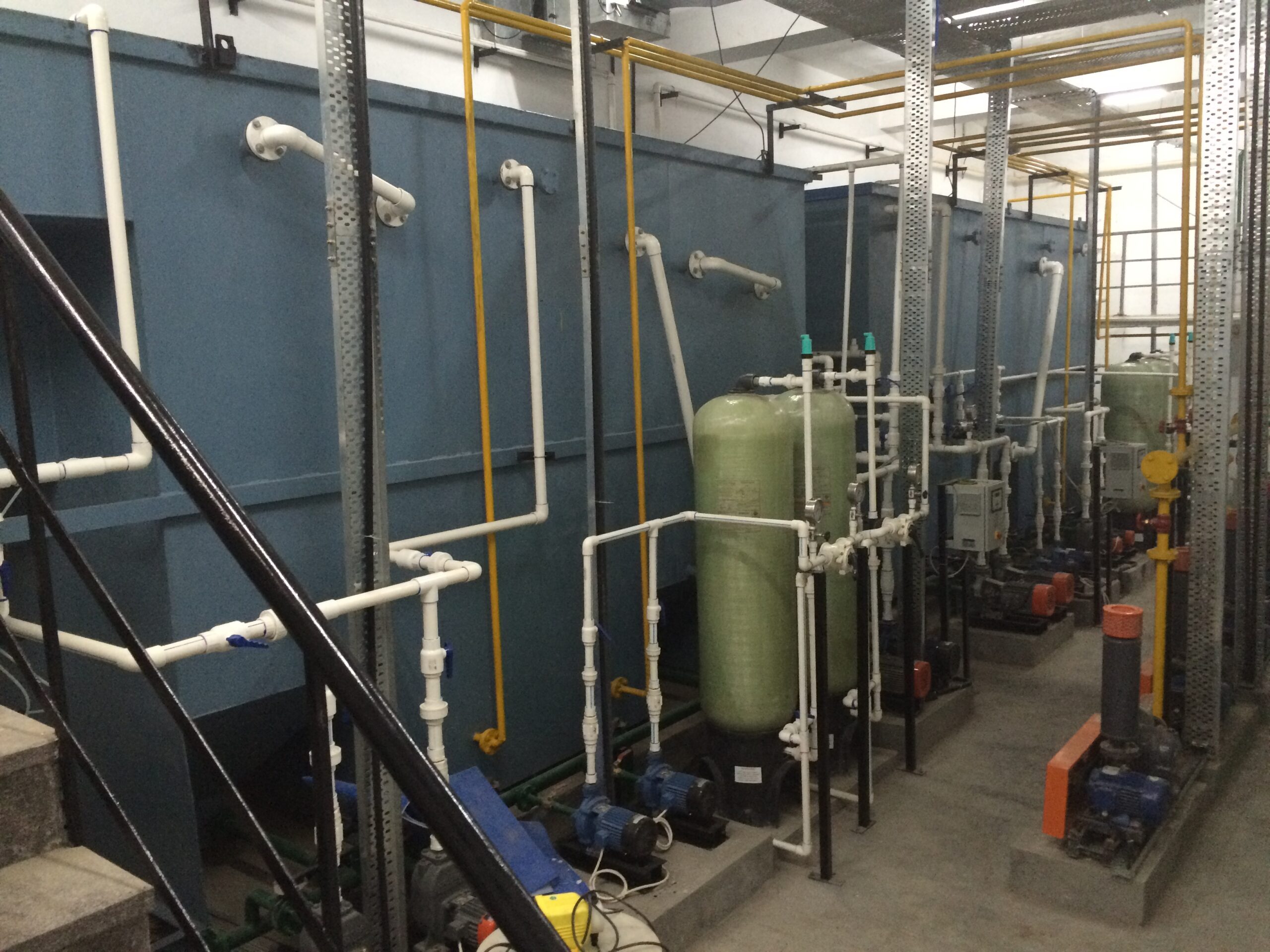
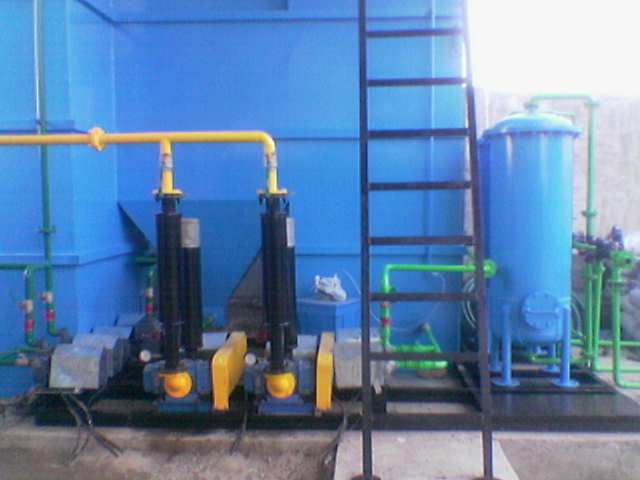
Waste water may be sewage or effluent water to make use for various utilities like gardening, recycling or even for industrial use like cooling tower make – up water.
INTRODUCTION
For removal of raw water dissolved salts, to make water free from soluble salts of Calcium, Magnesium & Sodium, water demineralisation plants are advisable. Raw water which contains chlorides, sulphates & carbonates of Calcium, Magnesium & Sodium make water unfit for use in the pharmaceutical, chemical & battery manufacturer industries and for high pressure boilers. The units can be different types depending on feed water quality and required treated water quality. The process of demineralization defined as under:
SAC – SBA
SAC – SBA — MB
SAC – DG – SBA
SAC – DG – SBA – MB
SAC – DG – WBA – SBA
SAC – DG – WBA – SBA – MB
CATION EXCHANGE
In demineralising, the cation exchange resin is used in the hydrogen form (RH). The ions in the water re actually freely moving but for the purposes of simplicity then may be identified as definite pairs.
INLET WATER QUALITY
Because an ion exchange resin must be kept clean to function efficiently, the inlet water or raw water must be cold, clean and colourless. The water should be free of suspended matters, organic matter, oil, algae, slime and heavy metals such as iron, aluminum. These impurities would collect on or within the resin particle and reduce their capacity for removal of the ions. Hence waters may require coagulation and filtration prior to being fed into the deionizer. The ion exchange resin particles can act as filters but their deionising ability and capacity will suffer and the resin bed may then require frequent cleaning or replacement.
CAPACITY BETWEEN REGENERATIONS
The capacity of the deionizer between regenerations depends on the type and quantity of ion exchange resins used in the columns, the quantity of acid and alkali used per regeneration of each respective column and the dissolved ionic content of the raw water. An economical quantity of regeneration chemical has been specified in the technical data sheet.
ANION EXCHANGE
There are several types of anion exchange resins which differ in basicity. Commonly used are the strong base (SB) anion exchange resins such as type-I or Type-II. The strong base resins are completely ionized throughout the complete pH range and can remove all acids – strong acids such as hydrochloric and sulphuric acids and weak acids such as silica and carbonic acid. Weak base resins are ionized only at a low pH and can, therefore, remove only the strong acid. Weak acids pass through the resin unaffected.
In demineralising, the anion exchange resin is used in the basic or hydroxide form. If the treated water from the cation exchange resin is passed through the anion exchange resin, the acids are removed.